

The federal Cheaper Home Batteries Program has transformed into one of Australia’s most transformative renewable energy initiatives but with sweeping changes that took effect on 1 May 2026 homeowners renters and installers across the country are grappling with a flood of questions. In just nine months after the program launched in July 2025 more than 250000 batteries were installed in Australian households making it a runaway success that exceeded government expectations. This unprecedented uptake forced the federal government to adjust how rebates work to ensure the program remains sustainable through 2030.
At the time of writing late May 2026 Australians are still navigating the new tiered rebate system understanding eligibility requirements and deciding whether now is the right time to invest in home battery storage. With approximately 7.2 billion dollars in funding allocated to support over 2 million batteries nationwide the program represents one of the most significant clean energy investments in Australian history.
This comprehensive guide answers the most common questions Australians are asking about the Cheaper Home Batteries Program in 2026 helping you make an informed decision about whether a home battery is right for your household.
Yes this is one of the most fundamental requirements. Your battery system must be connected to rooftop solar panels either existing or newly installed. The programs design encourages homeowners to first generate their own clean energy through solar before storing it in batteries for later use. If you do not have solar yet you can install panels and a battery together as part of a combined system and you will still qualify for the battery rebate.
Renters can claim the rebate but only with explicit permission from their landlord. The landlord must authorize the installation and agree to the rebate claim. Interestingly landlords themselves can claim the rebate for multiple rental properties but only one battery rebate per property address. This provision has opened up opportunities for investment property owners to upgrade their rentals with battery storage potentially increasing property value and reducing tenant energy costs.
No the rebate is not means tested. Any homeowner or renter with landlord permission can claim regardless of income level. This universal eligibility makes the program accessible across all socioeconomic groups from low income households to high earners. The governments intention is to accelerate battery adoption across all segments of the population not just those who can afford premium pricing.
Yes you can replace an existing battery and claim the rebate but there is a critical limitation only one rebate per property over the programs lifetime through 2030. If your property has already received a battery rebate you cannot claim again for a replacement. This rule prevents repeated claims on the same property and ensures the program reaches more households.
Off grid properties do qualify for the rebate but with specific conditions. You must be at least 1 kilometer away from the electricity grid or the cost to connect to the grid must exceed 30000 dollars. This provision recognizes that off grid homes often face higher energy costs and benefit significantly from battery storage to maximize solar generation.
Yes provided the battery is installed on private property not common area and the strata corporation approves the installation. Each individual lot can claim one rebate if it meets other eligibility criteria.
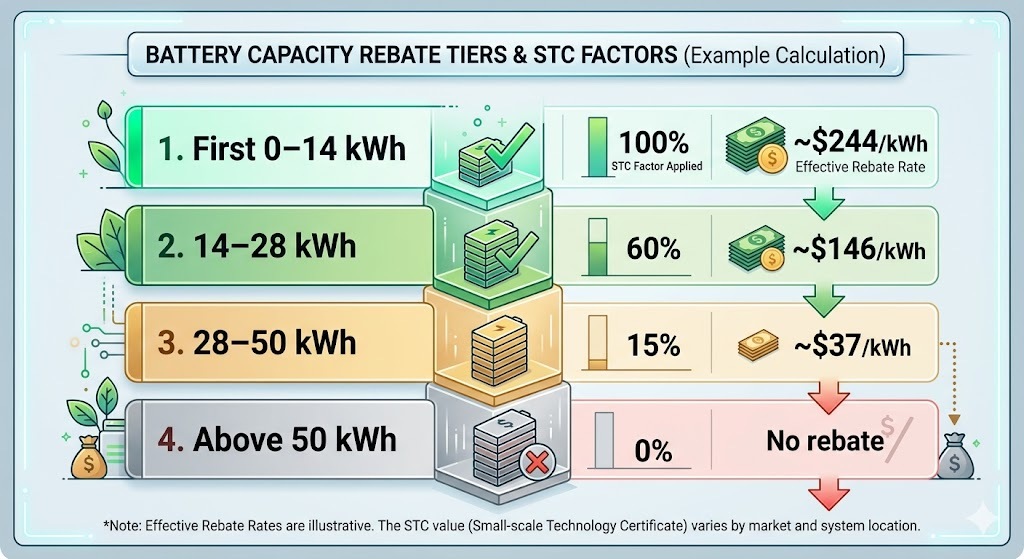
Starting 1 May 2026 the rebate operates on a tiered system based on battery capacity. The new structure rewards practical battery sizes while reducing incentives for oversized systems.
For the first 0 to 14 kilowatt hours inclusive the STC factor is 100 percent with an effective rebate rate of approximately 244 dollars per kilowatt hour. For 14 to 28 kilowatt hours inclusive the STC factor is 60 percent with an effective rebate rate of approximately 146 dollars per kilowatt hour. For 28 to 50 kilowatt hours inclusive the STC factor is 15 percent with an effective rebate rate of approximately 37 dollars per kilowatt hour. Above 50 kilowatt hours there is no rebate.
For a typical 13.5 kilowatt hour battery like a Tesla Powerwall 2 or similar you would receive approximately 3300 dollars off the installation price. For a larger 20 kilowatt hour system the rebate would be roughly 4700 dollars.
The program became a victim of its own success. The federal government announced in December 2025 that the rapid adoption rate was unsustainable under the old flat rate system. With over 250000 batteries installed in just nine months the original funding trajectory would have been exhausted by 2027 instead of lasting through 2030.
To address this the government added an additional 4.9 billion dollars in funding but introduced tiered rebates to better target household needs. The logic is that most Australian homes do not need batteries larger than 14 to 20 kilowatt hours so the highest rebate tier focuses on that practical range.
Yes and this is crucial for anyone considering a battery purchase. The STC Small-scale Technology Certificate factor drops every six months in January and July through 2030. This means the rebate amount will gradually decline over time with larger batteries seeing the most significant reductions.
For example the STC factor for batteries above 14 kilowatt hours will continue to decrease from the current 60 percent and 15 percent tiers. If you are planning to install a battery in the next 6 to 12 months timing your installation before the next STC drop could save you thousands of dollars.
Exactly. The new system deliberately discourages oversized batteries that most households do not need. A 50 kilowatt hour battery would receive only about 5200 dollars in rebates compared to what would have been over 12000 dollars under the old flat rate. Meanwhile a 13.5 kilowatt hour battery still receives the full 3300 dollar rebate.
This tiered approach reflects research showing that most Australian homes can meet their energy needs with batteries in the 10 to 20 kilowatt hour range especially when paired with rooftop solar and smart energy management.
No this is a common misconception. Your battery must be VPP capable meaning it has the technology to connect to a VPP if you choose but you are not required to actually join a VPP program. You retain full control over whether to participate.
VPPs allow multiple batteries to coordinate and sell excess energy back to the grid potentially generating additional income. But joining is entirely optional and many homeowners choose not to participate for privacy or control reasons.
Eligible batteries must have a nominal capacity between 5 kilowatt hours and 100 kilowatt hours. However the rebate only applies to the first 50 kilowatt hours of usable capacity. Any capacity above 50 kilowatt hours receives no rebate.
Most popular home batteries fall comfortably within this range including Tesla Powerwall 2 at 13.5 kilowatt hours LG Chem RESU at 9.3 to 16 kilowatt hours Enphase IQ Battery at 3.3 to 13.5 kilowatt hours and BYD Battery Box at 4.8 to 20.5 kilowatt hours.
Yes this is a hard requirement. Both your battery and inverter must be on the Clean Energy Council CEC Approved Products List. This ensures safety quality and compatibility with Australias electrical standards. Installers must also be CEC accredited to claim the rebate.
Using non approved equipment voids the rebate and may create safety risks. Always verify equipment approval before purchasing.
Yes you can expand an existing battery system and claim the rebate under specific conditions. The original system must not have claimed a rebate the additional capacity must be at least 5 kilowatt hours and the total system must still meet other eligibility requirements. This allows homeowners who initially installed a small battery to upgrade later while still accessing the rebate.
You do not apply directly to the government. Instead the process is handled by your CEC accredited installer. You get quotes from approved installers the installer claims the Small-scale Technology Certificates STCs on your behalf the rebate value is deducted from your upfront installation price and you pay the discounted price and receive the installed system. This streamlined process means you receive the benefit immediately rather than waiting for reimbursement.
No this myth has been thoroughly debunked. You retain full ownership and control of your battery. The rebate is simply an upfront discount funded through STCs a market based mechanism not a government loan or lease arrangement. Your battery operates according to your settings and preferences.
This depends on your system configuration. Standard grid tied batteries automatically shut down during blackouts for safety reasons to prevent back feeding electricity into lines being repaired by utility workers. To get backup power during outages you need a hybrid inverter or an additional backup gateway device. Not all batteries include this capability by default so specify backup requirements when getting quotes.
This is arguably the most important question for potential buyers. While battery prices may gradually decline over time the rebate is decreasing faster than prices are dropping. Your rebate amount is locked in at your installation date so waiting means facing lower STC factors and smaller rebates.
Industry experts recommend acting within the next 6 to 12 months if you are seriously considering a battery as the next STC factor drop is likely in January 2027.
Yes the federal rebate stacks with state based rebates. For example Western Australia offers additional battery incentives Victoria has the Solar Homes Battery Scheme and South Australia has its own battery programs. Combining federal and state rebates can significantly increase your total savings. Check your states energy website for current programs.
Despite the changes the Cheaper Home Batteries Program remains one of Australias most valuable clean energy incentives. The program is uncapped and funded through 2030 with approximately 7.2 billion dollars to support over 2 million batteries nationwide.
Key takeaways include the rebate is still substantial at approximately 244 dollars per kilowatt hour for batteries up to 14 kilowatt hours timing matters so act before the next STC factor drop the program is accessible to most homeowners and renters quality matters so use only CEC approved equipment and installers and the rebate stacks with state incentives for maximum savings.
If you are considering a home battery the best action is to consult with multiple CEC accredited installers who can apply the current rebate ensure your system meets all requirements and help you determine the right size for your households energy needs. With power prices rising and feed in tariffs falling a battery paired with solar can deliver both financial savings and energy independence for 15 plus years.
Contact Polygon Energy today 0482076703 or visit here to get your free Cheaper Home Batteries Program quote and learn the current rebate status before the next update drops in January 2027.