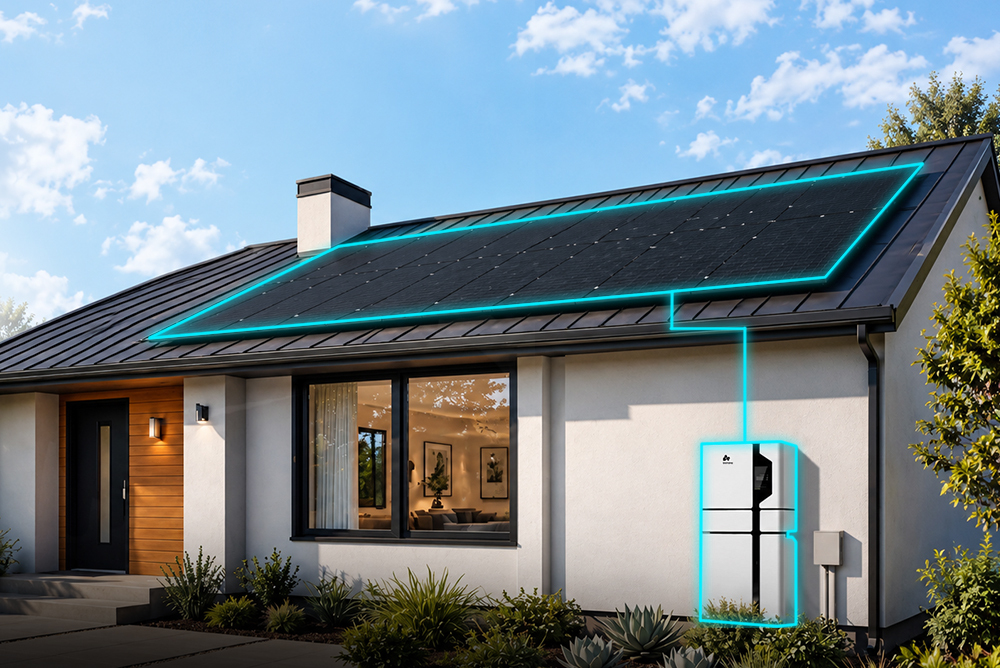
Australia’s energy market is changing fast. Rooftop solar is mainstream. Batteries are moving to the center. And households have more control over their energy than ever.
So the question is no longer “Should I get solar?”
It’s this: How much energy do I use? When do I use it? How much solar am I generating? What size battery actually makes sense? And how do I build a system that keeps delivering value for years?
At Polygon Energy, we see this as a turning point. Technology is getting better. Government support is evolving. The way we use electricity is changing. But one thing stays the same: the right system is designed around your property, your needs and the way you actually use energy.
1. Batteries are now part of the core conversation
Battery storage is growing quickly. It’s no longer just an optional extra.
The Australian Government’s Cheaper Home Batteries Program lowers the upfront cost of eligible batteries connected to new or existing rooftop solar. It began on 1 July 2025 and supports households and small businesses through the Small-scale Renewable Energy Scheme.
The scale is significant. Funding is now estimated at around $7.2 billion over four years, with a goal of more than two million battery installations by 2030.
But a rebate is only one part of the decision.
The right battery works with your solar generation, your daily usage, your roof space, your inverter and your future energy needs. Bigger isn’t better. Better designed is better.
That’s why we treat a battery as part of a complete energy system, not a standalone product.
2. NSW makes upgrading more affordable
NSW is leading the way in household electrification, with several programs that lower the cost of getting started.
The NSW Government’s Home Energy Saver program offers eligible households zero-interest loans of up to $15,000 for rooftop solar, batteries, insulation, air conditioning, EV chargers and switchboard upgrades. Eligible households can also receive discounts of up to $4,000, subject to program requirements.
This matters because the energy transition is no longer about a single technology. Solar, batteries, efficient appliances, electric vehicles, heating, cooling and energy management are becoming one connected household energy strategy.
If you’re looking into a Battery rebate NSW, it helps to see how the programs fit together. The previous NSW general household battery discount is no longer available. The Cheaper Home Batteries Program is now the primary federal battery discount.
There are also additional incentives linked to Virtual Power Plants, which let eligible battery owners help coordinate stored energy and supply the grid when it’s needed.
The result: batteries are no longer just backup. They’re flexible energy assets.
3. From generating energy to managing it
Australia has one of the highest rates of rooftop solar in the world. In NSW, more than half of homes have solar, and around 13,000 new batteries are being installed each month.
That changes the challenge.
Solar generates during the day. Many households use the most energy in the morning and evening. A battery bridges that gap. Instead of exporting your excess solar and buying power back later, you store it and use it when you need it.
That’s why Home battery installation is increasingly relevant for homes that already have solar.
But more storage doesn’t automatically mean better results. An oversized battery raises the upfront cost without proportional savings. One that’s too small can’t capture enough solar or cover peak usage.
The goal is balance.
4. A more decentralised energy system
Australia’s grid is moving away from central generation alone.
AEMO’s 2026 Integrated System Plan points to a growing role for renewables, storage and consumer energy resources. Its modelling suggests electricity consumption could nearly double by 2050 as transport, heating, cooking and industry electrify.
Households are becoming active participants. A home with solar and a battery can generate, store, use and, where eligible, share energy through a Virtual Power Plant.
So anyone planning a Home battery installation should think beyond today. The battery you choose should fit where your home is going, not just where it is now.
5. Quality matters more as the market grows
Rapid growth has created a bigger, more competitive installation market. That puts engineering and installation standards in sharper focus.
If you’re comparing Quality solar systems NSW, the panel is only one piece. A system is also the inverter, mounting, wiring, protection equipment, monitoring and workmanship. How they’re chosen and integrated shapes performance, safety and long-term reliability.
Our approach starts with your site: roof orientation, shading, available space, current usage, existing equipment and future needs. The goal isn’t to sell the most equipment. It’s to design the right system, which is what Quality solar systems NSW should really mean.
6. Off-grid systems still matter
Most Australian homes are connected to the grid. But in rural and remote areas, standalone systems remain essential.
Where grid connection is unavailable, unreliable or too expensive, solar and battery storage can offer real independence. Solar, batteries, intelligent energy management and backup generation can work together as one carefully designed system.
Off-grid design demands more planning. There’s no grid to fall back on, so demand, battery capacity, seasonal conditions, peak loads and backup generation all need careful assessment.
This is where professional design matters most.
7. Incentives are expanding beyond the family home
Battery incentives are now reaching apartments, small businesses and larger commercial and industrial sites.
New NSW Peak Demand Reduction Scheme battery activities now cover apartments, small and medium businesses, and commercial and industrial customers. NSW has also introduced an apartment building battery incentive, with higher discounts when storage is paired with new or additional solar.
For anyone tracking Battery rebate NSW options, the picture is broader than it used to be.
Apartment buildings, councils and businesses can all use stored energy more strategically, especially where demand peaks at particular times of day.
8. The next phase is right-sizing
More incentives mean more choice. And more choice means more complexity.
You might see 10 kWh, 13.5 kWh, 15 kWh and 20 kWh options and assume more capacity means more value. It doesn’t.
Battery economics depend on how much energy the system can actually use, how much solar is available to charge it, your consumption profile and your tariff. The same battery can perform very differently in two different homes.
That’s why Home battery installation should begin with analysis, not a product catalogue.
We look at solar generation, consumption, battery capacity and inverter compatibility before recommending anything. Right system. Right size. Right price.
9. Timing matters. Design comes first.
Incentives can make a battery more accessible. But don’t rush a decision because of a headline number.
Support under the Cheaper Home Batteries Program is designed to reduce progressively over time. NSW programs continue to evolve too.
Researching a Battery rebate NSW? Check current eligibility, and confirm exactly which incentive applies to your system. A good installer will explain the incentive, the design, the installation requirements and the expected performance clearly.
The rebate should support a good decision. It shouldn’t be the reason for one.
10. Electrification is connecting everything
Solar and batteries are now considered alongside EVs, heat pumps, induction cooking, efficient air conditioning and electric hot water. Home Energy Saver reflects this, covering everything from rooftop solar to EV chargers, heat pumps, insulation and switchboard upgrades.
So your home’s electrical infrastructure matters more than ever. Solar today, an EV charger tomorrow, a heat pump next year.
The best Quality solar systems NSW are designed with that future in mind.
What this means for NSW homeowners
Australia’s energy industry is maturing.
First, the question was whether solar made sense. Then, whether to add a battery. Now, it’s how everything works together.
For anyone comparing Quality solar systems NSW, look beyond panel specs. Consider design, installation quality, monitoring, warranties, engineering, after-sales support and whether the company truly understands your energy profile.
For Home battery installation, the same rule applies. The right battery isn’t the biggest or the cheapest. It’s the one that fits how your home generates and uses energy.
And before you commit to a Battery rebate NSW or the Cheaper Home Batteries Program, check the current rules and eligibility.
The Polygon Energy approach
At Polygon Energy, we believe Australia’s energy transition should be built on better decisions, not just more technology.
The direction is clear. Solar is expanding. Storage is accelerating. Electrification is lifting demand. Government programs are backing household and business investment. And consumers have more control than ever.
But every property is different. So we start with your site, your energy profile and your priorities.
We design Quality solar systems NSW homes and businesses can rely on, with a focus on practical engineering, safety, performance and long-term value. We plan every Home battery installation as part of a complete system. And we’ll explain each Battery rebate NSW incentive that applies to you, including the Cheaper Home Batteries Program.
The goal isn’t more panels or more batteries. It’s energy systems that work intelligently for the people using them.