
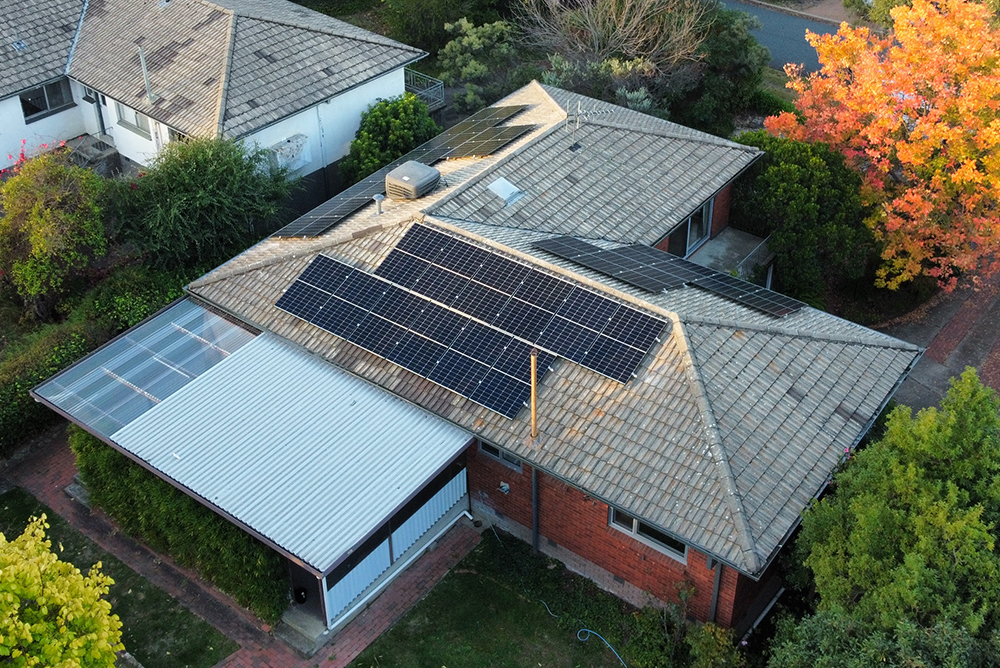
Australia’s energy market is entering a new phase.
More than 500,000 batteries have now been installed under the Federal Government’s Cheaper Home Batteries Program, marking one of the most significant milestones in Australia’s transition towards distributed energy storage.
But the importance of this milestone goes beyond the number of batteries installed.
It reflects a fundamental change in the way Australian households are thinking about energy.
Solar panels allow homes to generate electricity. Batteries allow them to decide when that electricity is used.
That distinction is becoming increasingly important as electricity prices, household energy consumption and electrification continue to evolve.
For homeowners in New South Wales, the current market presents an interesting opportunity. The federal program remains active, providing eligible households and small businesses with around a 30% discount on eligible small-scale batteries connected to new or existing rooftop solar.
At Polygon Energy, we believe the most important conversation isn’t simply about installing a battery.
It is about understanding how a battery fits into the entire energy system.
The Federal Government launched the Cheaper Home Batteries Program on 1 July 2025 to make battery storage more accessible to Australian households and small businesses.
The program is delivered through the Small-scale Renewable Energy Scheme (SRES), with eligible installations receiving support through Small-scale Technology Certificates.
The government originally estimated funding of $2.3 billion for the program. Following strong uptake, that estimate was expanded to approximately $7.2 billion over four years, with an ambition to help more than two million Australians install batteries by 2030.
That makes one point particularly important for homeowners considering storage today:
It is still operating, although the incentive structure has changed.
From 1 May 2026, the government introduced a tiered approach to battery incentives. This means the level of support varies according to usable battery capacity, encouraging homeowners to select systems that are appropriately sized for their energy requirements.
This is a sensible evolution of the policy.
A government incentive can reduce the upfront cost of a battery, but it shouldn’t be the reason someone installs a battery that is larger than they actually need.
The better question is:
What battery capacity makes sense for my home, my solar generation and my electricity consumption?
For NSW homeowners researching the Battery rebate NSW, it is important to distinguish between the federal battery incentive and any state-specific programs.
The Federal Government’s Cheaper Home Batteries Program is available nationally to eligible customers. NSW residents may also have access to additional state-based incentives or Virtual Power Plant opportunities depending on their circumstances. The Australian Government currently lists a NSW Virtual Power Plant incentive that can provide benefits to eligible NSW residents who connect a solar battery to a participating VPP.
This means the overall economics of battery storage can depend on more than one factor.
A homeowner should consider:
The NSW solar battery rebate conversation therefore needs to move beyond simply asking, “How much is the rebate?”
The more useful question is:
“What will my complete energy system cost, save and deliver over its lifetime?”
That is where professional system design becomes important.
One of the biggest misconceptions in the battery market is that a larger battery automatically means greater savings.
It doesn’t.
A battery is valuable when its capacity aligns with the amount of energy a household can realistically store and use.
For example, a home with relatively low evening electricity consumption may not benefit financially from installing an excessively large battery.
On the other hand, a household with high evening consumption, electric vehicle charging, electric hot water or significant heating and cooling loads may benefit from greater storage capacity.
This is one reason the government’s revised incentive structure encourages more considered battery sizing. The program’s changes were specifically designed to encourage households to choose the right-sized battery for their needs and keep the scheme sustainable.
At Polygon Energy, we approach battery design from the same principle.
The objective isn’t to sell more storage. The objective is to design the right energy system.
Australia has already established itself as one of the world’s leading rooftop solar markets.
The next stage is increasingly about combining solar generation with storage.
Without a battery, excess solar generated during the middle of the day may be exported to the grid.
With a correctly sized battery, some of that energy can instead be stored and used later in the evening when household demand rises and solar generation falls.
This changes the role of rooftop solar.
Instead of simply generating electricity when the sun is shining, a solar-and-battery system can help households shift their renewable energy across the day.
The Federal Government describes this as one of the key benefits of the current battery program: storing inexpensive renewable energy generated during the day so it can be used when it is needed most.
For homeowners considering a Battery program NSW opportunity, this is the bigger picture worth understanding.
The battery is not an isolated appliance.
It is part of an integrated energy system.
Battery storage becomes even more important when there is no reliable connection to the electricity grid.
An Off grid solar system needs to do more than generate electricity.
It needs to manage energy production, storage and consumption carefully enough to maintain supply when solar generation is unavailable.
This is where system design becomes significantly more complex.
A typical grid-connected solar system can export excess generation and draw electricity from the grid when required.
An off-grid system cannot rely on that safety net.
The system therefore needs to consider:
For properties in regional and remote NSW, a properly engineered Off grid solar system NSW solution can provide greater energy independence where grid connection is unavailable, unreliable or economically impractical.
However, off-grid systems should never be designed simply by adding more panels and a larger battery.
They require careful energy modelling and an understanding of how the property operates throughout the year.
This principle can be seen in one of Polygon Energy’s residential projects: Comprehensive Solar and Battery Solutions for Continuous Residential Power.
The project focused on integrating solar generation and battery storage to create a more resilient residential energy system.
Rather than treating the battery as an add-on, the solution considered how generation and storage would work together across the home’s energy cycle.
This is precisely the approach that becomes important as Australia’s battery market matures.
Technology provides the capability.
Good engineering determines how effectively that capability is used.
You can explore more of Polygon Energy’s residential solar and battery projects through its case studies.
The most significant impact of the federal incentive may ultimately be behavioural.
For years, Australians have been encouraged to install rooftop solar because it can reduce the amount of electricity purchased from the grid.
The battery market introduces another question:
That is the fundamental proposition behind residential storage.
And it is why the Battery incentive should be viewed as an opportunity to evaluate an entire energy strategy—not simply as a discount on a piece of equipment.
A well-designed solar and battery system can potentially:
But the outcome depends heavily on how the system is designed and operated.
The rapid growth of battery storage presents an important lesson.
Government incentives can accelerate technology adoption, but the long-term value of that technology depends on how intelligently it is deployed.
That is particularly relevant for NSW homeowners evaluating the Battery rebate NSW and trying to understand whether battery storage makes financial sense for their property.
The starting point should always be the household’s actual energy profile.
Before selecting a battery, homeowners should understand when they use electricity.
A household that consumes most of its electricity during the day may already be using a significant portion of its solar generation directly.
A household that consumes heavily in the evening may have a much stronger case for battery storage.
Consider common loads such as:
The objective is to understand the gap between when solar is generated and when electricity is consumed.
That gap is where a battery can create value.
The next stage of Australia’s energy transition will not simply be about more generation and more storage.
It will be about better management.
Smart monitoring can help homeowners understand:
This visibility can make a significant difference to how effectively a system performs.
It also supports better long-term decisions.
As households add electric vehicles, heat pumps, induction cooking and other electrified technologies, their energy profiles can change.
A solar and battery system should therefore be considered as part of a broader home electrification strategy, rather than as a standalone purchase.
Polygon Energy’s case-study portfolio includes a 23.6 kW Solar with Battery Near-Zero Electricity Bills project.
It provides a useful illustration of what can happen when substantial solar generation is combined with battery storage and designed around the property’s energy requirements.
The objective wasn’t simply to install a large amount of solar.
It was to create a system capable of generating significant renewable energy and using storage to make that generation more useful across the day.
This is an important distinction.
For homeowners evaluating battery storage, real-world project outcomes can therefore be more informative than simply comparing battery capacities on a specification sheet.
Polygon Energy’s case-study library provides further examples of residential and commercial systems designed around different energy requirements.
For customers searching for an Off grid solar system NSW solution, the considerations become even more detailed.
An off-grid property needs enough generation and storage to manage periods when solar production is low.
This means system designers need to account for seasonal variations.
A system that performs well during a sunny summer period may need additional generation or storage to maintain reliability through winter.
Load management is also critical.
Large electrical loads can place significant pressure on an off-grid system, particularly when multiple appliances operate simultaneously.
For this reason, an effective Off grid solar system often combines:
Solar generation + battery storage + inverter technology + energy monitoring + load management + backup planning
The result is not simply energy independence.
It is a carefully engineered energy ecosystem.
There is another reason the battery boom matters.
Hundreds of thousands of batteries operating independently represent a significant distributed energy resource.
When connected through technologies such as Virtual Power Plants, batteries can potentially be coordinated to support the wider electricity system.
NSW already has a government-listed VPP incentive for eligible residents, where participating batteries can be remotely coordinated to provide grid support.
This creates an interesting future.
The battery installed in a home today could eventually become part of a much larger network of distributed energy resources.
The Battery program NSW landscape is therefore about more than household savings.
It is also becoming part of the broader transformation of Australia’s electricity system.
The battery market has matured quickly.
With more products, more installers and stronger government support, consumers have more choices than ever.
That makes informed decision-making increasingly important.
When evaluating a system, consider:
Don’t select capacity simply because it attracts a larger incentive.
Choose a size based on your actual consumption and future requirements.
The battery should work effectively with the existing or proposed solar system.
The inverter is central to how electricity moves between solar panels, batteries, household loads and the grid.
If backup power is important, understand exactly which household circuits can be supported during an outage.
Good monitoring provides visibility into system performance and energy consumption.
Battery systems require appropriate design, installation and compliance expertise.
Look beyond the upfront rebate and consider the system’s expected performance, savings and payback over its useful life.
The current Battery incentive makes battery storage more accessible to many Australians.
But the incentive should be considered as one component of the investment decision.
The cheapest system isn’t necessarily the best system.
And the largest battery isn’t necessarily the most economical.
The better approach is to consider the complete equation:
Energy consumption + solar generation + battery storage + tariffs + system design + future requirements.
This is where an experienced energy partner can add value.
Australia’s 500,000-battery milestone demonstrates that storage has moved firmly into the mainstream.
But the next phase of the market will be defined by something more important than installation numbers.
It will be defined by how intelligently these systems are designed and operated.
For NSW households, the opportunity is particularly relevant.
The federal NSW solar battery rebate landscape is evolving, the national Cheaper Home Batteries Program remains active, and additional opportunities such as VPP participation are emerging.
At the same time, households are becoming more electrified.
EVs, heat pumps, electric hot water and other technologies are increasing electricity demand and changing when energy is consumed.
That makes energy planning increasingly important.
At Polygon Energy, we don’t believe battery storage should be approached as a one-size-fits-all purchase.
Every property has a different roof.
Every household has a different consumption profile.
Every business has different operational requirements.
And every energy system has a different set of priorities.
Our role is to understand those requirements and engineer a solution around them.
Whether you are considering rooftop solar, a battery, an Off grid solar system NSW solution or a broader renewable energy strategy, the right starting point is not the product catalogue.
It is the energy profile.
Understand first. Design second. Install with purpose.
That is how renewable energy becomes a long-term asset rather than simply another household purchase.
If you’ve been waiting to explore battery storage, the current federal program means it is worth understanding your eligibility and the economics of your system now.
The Australian Government continues to provide around a 30% discount on eligible small-scale batteries connected to new or existing rooftop solar, subject to program requirements and applicable rules.
But don’t make the decision based on the rebate alone.
Understand your energy use.
Understand the battery capacity you actually need.
Understand how solar, storage and future energy loads can work together.
And then make an informed decision.
Explore Polygon Energy’s solar and battery solutions, view our real-world case studies and connect with our team to assess the right system for your energy needs.
Visit Polygon Energy → Explore Polygon Energy
Rebate eligibility, discount levels and program conditions can change. Always confirm current eligibility and applicable requirements before making an investment decision.